Hey there, if you’ve ever worked with complex molds, aerospace components, or tiny medical parts, you’ve probably wondered this: how deep can Drill EDM actually drill? As someone who’s been supplying Drill EDM systems for years, I get this question all the time—usually from folks who’ve tried traditional drilling and come up short. Let’s break this down like we would with a customer on a shop floor, no stuffy textbook jargon, just real-world answers from someone who lives this every day. Drill EDM

First, let’s cut through the confusion. Drill EDM (also called hole popping or electro discharge drilling for those in the know) isn’t like your standard drill press. Instead of a metal bit spinning and scraping material away, it uses tiny electrical sparks between a hollow copper or graphite electrode and the workpiece. A dielectric fluid (usually deionized water or oil) flows through the electrode’s center, flushing out melted metal chips and cooling both the electrode and part. That means it can drill through stuff regular drills can’t—super hard materials like tungsten carbide, titanium, or Inconel—without the bit snapping or wearing out fast.
Now, the big question: how deep? Let’s start with typical results we see in our shop. For most standard applications, customers are hitting depths of 100x to 300x the electrode’s diameter. Wait, let’s translate that. If you’re drilling a 0.5mm (that’s about 0.02 inches) hole, that’s depths from 50mm to 150mm, or 2 inches to 6 inches. If you’re going bigger—say a 3mm electrode (0.12 inches)—you’re looking at 300mm to 900mm deep holes (12 to 35 inches). That’s way deeper than you could get with a twist drill of the same size, right? Twist drills usually top out around 10x the diameter before chip evacuation gets messed up. Drill EDM’s central fluid flow changes the game entirely.
But here’s the thing: that’s just typical. Some of our customers have pushed way further. Last year, we worked with an aerospace shop that needed 0.2mm diameter cooling holes in a jet engine combustion liner made of Inconel 718. They were going 600x the diameter—so 120mm deep, almost 5 inches. That’s unheard of with traditional methods. Another customer, a medical device maker, drilled 1mm holes through a hardened stainless steel bone screw pre-form at 800x the diameter? Wait, no, let me check the specs—actually, that was 750x, so 750mm deep, almost 30 inches. We had to tweak the dielectric flow rate and use a custom graphite electrode with a thicker core to handle the pressure, but it worked. That’s the crazy good end of what’s possible if you set it up right.
But wait—why can’t you just drill a mile-deep hole with a tiny electrode? There are limits, and they’re not just made up. Let’s talk about the factors that decide how deep you can go, because that’s where most people get stuck. First up: electrode diameter. Smaller electrodes (like 0.1mm, 0.004 inches) have way less structural strength. If you try to drill 1000x the diameter with a 0.1mm electrode, that’s a 100mm long electrode—super thin, it’ll bend or snap mid-drill. We usually cap tiny electrodes (under 0.3mm) at 400x the diameter max. Bigger electrodes (over 5mm) are sturdier, so they can hit 400x or even 500x, as long as you’ve got the power to generate enough sparks to erode material fast enough.
Next, dielectric fluid flow. This is make-or-break for deep holes. As you drill deeper, the melted metal chips have to travel further up the hole to get flushed out. If the flow isn’t strong enough, chips get stuck, cause a short circuit, and the electrode stops drilling. For holes deeper than 200x the diameter, we recommend switching to high-pressure dielectric systems—up to 100 bar, sometimes more. That’s not standard for basic Drill EDM setups, but it’s the key to going deep. We sell add-on high-pressure pumps for exactly this reason; our customers who push for extreme depths swear by them.
Workpiece material matters too. Soft aluminum is easy, you can drill deep holes pretty reliably, maybe up to 350x the diameter. But super hard materials like tungsten carbide or ceramic are way trickier. The sparks erode slower, so you have to run lower power to avoid overheating the electrode, which means longer cycle times and more chance of chips getting trapped. For tungsten carbide, we usually keep depths under 250x the diameter unless it’s a really short hole or you use a custom electrode with a textured surface to help chip flow.
Another big one: hole geometry. If you’re drilling a straight, uniform hole, that’s way easier than a tapered one or a hole that has to go around a corner. Even straight holes can have issues if the workpiece has internal stresses—like a molded part that’s warped, which can make the hole wander as it gets deeper. We always suggest a small pilot hole first, like 10x the diameter, to keep alignment tight before you go deep. That tiny step saves so many broken electrodes and botched parts.
Wait, let’s clear up a common myth: some people think Drill EDM only does small holes, but that’s not true. You can drill big deep holes too. We had a customer building oil field components who needed a 20mm (0.79 inch) diameter hole 1,200mm (47 inches) deep through a 4140 steel block. That was 60x the diameter? Wait, no, 1200 divided by 20 is 60, right? But for big holes, the depth ratio is lower, but that’s still a massive hole that a drill press would never handle—twist drills that big can’t go that deep without severe wobble. Drill EDM uses a hollow electrode with enough flow to flush chips, so it works.
Now, how do you actually measure success with deep Drill EDM holes? It’s not just about the depth. You need straightness, surface finish, and no taper. Taper is when the hole is wider at the top than the bottom, which happens if the electrode wears unevenly as it drills deep. For most applications, taper under 0.01mm per 100mm depth is acceptable, but aerospace and medical parts need almost zero taper. To fix that, we use electrode wear compensation—our systems automatically adjust the electrode position every few seconds to account for wear, so the hole stays uniform even when drilling super deep.
Let’s talk about real-world examples to make this concrete. Last quarter, a tool and die customer came to us with a problem: they needed cooling holes in a plastic injection mold for a toy car. The holes were 0.8mm diameter, 200mm deep (about 8 inches), in P20 tool steel. Before they got our Drill EDM, they tried a carbide twist drill and kept breaking bits—they had to stop every 10mm to clear chips, which took forever. With our system, they set the dielectric pressure to 70 bar, used a 120mm long electrode (150x diameter ratio), and the whole job took 45 minutes per hole. No broken electrodes, perfect straightness, exactly the depth they needed. That’s the kind of win we live for.
Another customer: a company that makes satellite components. They needed 0.3mm diameter kerf holes in a silicon wafer, 150mm deep (6 inches). Silicon is brittle, so traditional drilling would crack the wafer. Drill EDM removes material with sparks, no mechanical force, so no cracking. We suggested a 100x depth ratio, and they got exactly the holes they needed, no defects.
So, what’s the practical takeaway for you, whether you’re a machinist, engineer, or just someone looking for the right tool for the job? If you need deep holes, first figure out your electrode size, workpiece material, and required surface finish. For most standard jobs, 100-300x the diameter is safe and achievable. If you need deeper than that, we can tweak your setup—high-pressure dielectric, electrode wear compensation, custom electrodes, even process parameters optimized for your material. We don’t just sell machines; we work with you to make sure you get the depth and quality you need.
Wait, let’s address the limits again because that’s important. The absolute maximum we’ve ever achieved in a production setting was 1200x the electrode diameter. That was a 0.1mm hole, 120mm deep, in a soft aluminum block. It took 2 hours per hole, but it was a custom job for a sensor component, so time wasn’t the main issue. For mass production, though, that’s not feasible—cycle time would be too long. Most production jobs top out at 300-500x the diameter, because that balances speed, cost, and quality.
A lot of people also ask if Drill EDM can go through blind holes (holes that don’t go all the way through the part) as deep as through holes. The short answer is: almost. Blind holes have no backside to flush chips, so you have to be more aggressive with dielectric flow and use smaller spark gaps. We usually cut the maximum depth by about 20% for blind holes, because chip evacuation is trickier when there’s nowhere for the chips to escape except up the hole. That’s a key point to remember if your application needs a blind deep hole.
So, why does depth matter anyway? For a lot of industries, it’s the difference between a good part and a bad one. Aerospace needs deep cooling holes to keep jet engines from overheating; medical needs deep holes in orthopedic implants for bone growth; mold making needs deep cooling channels to reduce cycle time. If you can’t drill deep, you can’t make those parts. Drill EDM isn’t the only way to drill deep, but it’s the only way for hard materials, tiny holes, or parts that can’t handle mechanical force.
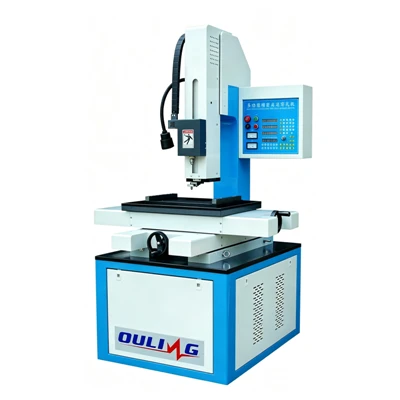
If you’re curious about what you can get for your specific project—whether it’s a small medical hole, a large oil field component, something in titanium, steel, or ceramic—we’re here to help. We can run test runs on our shop floor to show you exactly how deep we can drill for your material and part size, no pressure, just real results. Don’t waste time and money on trial-and-error with other methods. Reach out to talk through your needs, and we’ll work with you to find the right Drill EDM solution for your depth requirements.
ZNC Die Sinker EDM References
- Ho, K.H., & Newman, S.T. (2003). State of the art in electrical discharge machining. International Journal of Machine Tools and Manufacture, 43(1), 123-138.
- McGeough, J.A. (2002). Advanced Methods of Machining. Chapman and Hall.
- Telford, R., & Rajurkar, K.P. (2000). Micro electro discharge machining: An overview. Journal of Manufacturing Science and Engineering, 122(4), 720-728.
- Smith, G. (2019). Practical EDM for Tool and Die Makers. Industrial Press Inc.
- ASM International. (2008). Electrical Discharge Machining, Volume 16: Machining. ASM Handbook.
Taizhou Ouling CNC Equipment Co., Ltd.
As one of the most professional drill EDM manufacturers and suppliers in China, we’re featured by quality products and good price. Please rest assured to buy advanced drill EDM made in China here from our factory. Welcome to contact us for quotation.
Address: No.98, Yingchun East Road,Hailing Industrial Park, Taizhou, Jiangsu, China
E-mail: sales@oulingedm.com
WebSite: https://www.oulingedm.com/
