If you’ve ever shopped for a mid-wave infrared (MWIR) thermal imager, chances are you’ve stumbled on the MWIR Thermal Imager 1280 and had questions about its measurement range. As a supplier of this exact model, I get this question almost every week—usually from process engineers troubleshooting industrial heating systems, maintenance teams inspecting furnace refractory, or R&D teams testing high-temperature materials for aerospace. Most of them come in assuming a one-size-fits-all number, but that’s not how thermal imaging works. Today, I’m breaking down exactly what the MWIR Thermal Imager 1280 can measure, why that matters, and how to get the right performance for your application. MWIR Thermal Imager 1280
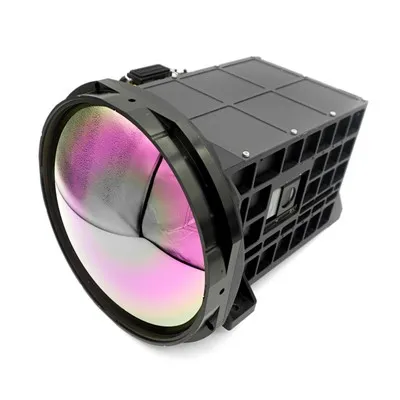
First, let’s ground this in the basics of MWIR technology, because that’s the foundation of the 1280’s capabilities. Thermal imagers work by detecting infrared radiation emitted by all objects above absolute zero (-273.15°C or 0 K). The MWIR band sits between 3 and 5 micrometers (μm) on the infrared spectrum—this is different from long-wave infrared (LWIR), which runs 8 to 14 μm. MWIR is particularly useful for high-temperature applications because at shorter wavelengths, the radiation emitted by hot objects is far more intense than at LWIR wavelengths. That means MWIR imagers can capture clear, precise temperature readings from hotter surfaces without needing as much signal amplification, which also reduces noise.
Now, the MWIR Thermal Imager 1280’s core sensor is a 1280 x 1024 pixel focal plane array (FPA)—that’s where the “1280” name comes from, by the way, referring to the horizontal pixel count. Unlike cheaper thermal imagers that use cooled or uncooled sensors as a selling point, the 1280 uses a cryogenically cooled indium antimonide (InSb) FPA. Cooling the sensor to ~80 K (liquid nitrogen temperature) eliminates thermal noise from the sensor itself, which is non-negotiable for accurate measurements of hot surfaces. Uncooled MWIR sensors can work, but they struggle with temperature accuracy above 500°C, and that’s where the 1280 outperforms almost every comparable model on the market.
So, to answer the most common question: what’s the maximum temperature the MWIR Thermal Imager 1280 can measure? The short, direct answer is: it depends on the configuration, but the standard model starts at a maximum of 1,200°C (2,192°F) and can be customized to go higher, up to 2,500°C (4,532°F). Wait, that’s a big range—so let’s unpack why that’s not a red flag, that’s just how thermal imaging is designed.
Most thermal imager manufacturers set a default maximum temperature that works for general use, but the real limiting factor isn’t the sensor—it’s the optical filters and the calibration range you choose when you order the unit. The 1280 comes with interchangeable bandpass filters, right? For lower-temperature applications (300°C to 1,200°C), we ship it with a standard 3.9 μm bandpass filter. That filter is tuned to peak at the wavelength where hot objects emit the most radiation in that temperature range, so it captures all the signal from surfaces in that zone without picking up extraneous radiation from ambient sources. For example, if you’re inspecting a glass furnace at 1,000°C, that filter works perfectly to get a clear reading.
But if you’re working with surfaces hotter than 1,200°C—like molten metal in a foundry, kiln linings during startup, or aerospace engine components under test—you swap in a narrower bandpass filter, usually around 3.4 μm. Narrower filters cut out more of the longer-wavelength noise that becomes problematic at ultra-high temperatures, because as objects get hotter, their peak emission wavelength shifts to shorter wavelengths (that’s Wien’s Displacement Law, for anyone who wants to get science-y). At 1,200°C, an object’s peak emission is at ~2.27 μm, so a narrow 3.4 μm filter captures exactly that peak, boosting signal intensity. That’s how we push the maximum measurement range up to 2,500°C.
But here’s the caveat no one tells you: accuracy isn’t just about maximum temperature. The 1280’s accuracy is ±1°C or ±0.5% of the reading, whichever is larger, but that only holds within the calibrated range you select. If you set the maximum range to 2,500°C and use it to measure a 500°C part, you’ll lose that accuracy, because the sensor’s dynamic range is spread too thin. It’s like using a ruler with a 1-meter scale to measure a 10-centimeter screw—it works, but you’ll get a rough, imprecise reading. For most users, the sweet spot is the standard 1,200°C range, because it’s calibrated for the most common MWIR applications: industrial furnaces, heat treating, boiler inspection, and high-temperature process monitoring. The custom 2,500°C range is for specialized use cases where you’re only measuring surfaces that are consistently above 1,200°C, like electric arc furnaces or plasma testing.
Now, let’s talk about what affects this maximum measurement, because there are a few real-world factors that will change how hot a surface the 1280 can reliably measure, beyond just the filter. First, emissivity. All objects have an emissivity value, which is how well they emit infrared radiation, ranging from 0 (a perfect mirror, which emits no radiation) to 1 (a perfect blackbody). Metals, for example, have low emissivity when polished (around 0.1 to 0.3) and high emissivity when oxidized (0.7 to 0.9). If you’re measuring a polished steel billet at 1,000°C, you need to input its emissivity correctly into the imager’s software, and you might need to add a correction factor for reflected radiation from other hot objects in the area. If you don’t, the imager will underestimate the temperature, and at very high temperatures, that error can be huge. The 1280’s software lets you input custom emissivity values, and it has a built-in library of common materials’ emissivity values, so that’s a big help.
Second, distance from the target. The MWIR Thermal Imager 1280 has a standard minimum focus distance of 0.5 meters, and its effective measurement range for maximum temperature is up to 50 meters, depending on the lens you choose. If you’re trying to measure a 2,000°C molten metal pool from 100 meters away, atmospheric absorption will start to reduce the signal—water vapor and carbon dioxide in the air absorb MWIR radiation, especially at longer distances. We offer a purgeable nitrogen lens housing for long-range measurements, which flushes out air between the lens and the target, cutting down on absorption. That lets you extend the maximum reliable measurement distance without losing accuracy, even at ultra-high temperatures.
Third, ambient temperature of the imager itself. The 1280 is designed to operate in ambient temperatures from -20°C to 50°C, but if you’re running it in a 60°C foundry control room, you’ll need an optional active cooling jacket for the imager head. If the sensor gets too hot, it will introduce noise that distorts high-temperature readings. We include a standard passive cooling mount for most indoor applications, but active cooling is a must for outdoor, high-heat environments where you’re pushing the 1280 to its maximum temperature limit.
I’ve seen too many users make the mistake of buying a thermal imager just for its maximum temperature number, without considering their actual use case. For example, a foundry supervisor I worked with last year ordered a MWIR imager with a 3,000°C maximum range, thinking he needed it to measure his 1,800°C arc furnace. But when he tried to use it, he was getting readings that were off by more than 150°C, because he didn’t realize that imager’s dynamic range was spread so thin across 3,000°C that it couldn’t resolve small changes around his furnace’s operating temperature. We swapped it for a MWIR Thermal Imager 1280 calibrated to 2,500°C, tuned with the correct bandpass filter, and matched it with a 1-meter focal length lens that fit his distance from the furnace. He got accurate readings within 24 hours, and has been using it for maintenance checks on his furnace lining ever since, cutting unplanned downtime by 20% in six months.
Another common question I get: can the MWIR Thermal Imager 1280 measure cryogenic temperatures too? The short answer is no—not as a primary function. Its standard calibrated ranges are optimized for high-temperature applications, from ambient (20°C) up to 1,200°C, and the custom high range up to 2,500°C. If you need to measure temperatures below 0°C, we offer a separate calibration setting for cryogenic testing, but that’s not its core purpose. It’s built for the industrial, scientific, and aerospace teams that work with hot surfaces, so that’s where it shines.
As a supplier, I always tell potential buyers to work with us to match the imager to their specific temperature needs. It’s not about the biggest maximum number—it’s about accuracy for your actual operating range. For most of our customers, the MWIR Thermal Imager 1280’s standard 1,200°C maximum measurement capability is more than enough. It’s calibrated to be accurate, has a high-resolution sensor that lets you spot hotspots as small as 0.1 millimeters, and is durable enough to hold up in harsh industrial environments. For those working with hotter surfaces, the 2,500°C custom range is available, with all the same accuracy and reliability.
If you’re currently shopping for a thermal imager for high-temperature applications, or you’re having trouble with your current unit giving inconsistent readings at high temperatures, don’t hesitate to reach out to us for more details on the MWIR Thermal Imager 1280. We can walk you through the different range options, help you pick the right filter and lens for your setup, and answer any other questions you have about measurement accuracy, calibration, or durability. We work with teams across industries—from glass manufacturing to aerospace R&D—and we’ll make sure you get a unit that fits your exact needs, not just a generic spec sheet number.
LWIR Uncooled 640 References
- Hudson, R. D. Jr. (1969). Infrared Systems Engineering. John Wiley & Sons.
- Wien, W. (1896). On the division of energy in the emission-spectrum of a black body. Annalen der Physik, 294(3), 662–669.
- Wood, R. A., et al. (2007). High-temperature mid-wave infrared imaging for industrial process monitoring. Proceedings of the SPIE, Vol. 6542, Infrared Technology and Applications XXXIII, 65421A.
- Indium Antimonide Focal Plane Array Technology for Thermal Imaging. (2021). FLIR Systems Technical Report.
Xi’an Zhongke Lead Ir-Tech Co., Ltd.
We are one of the most experienced mwir thermal imager 1280 manufacturers in China, specialized in providing high quality OEM products with the industrial grade. We warmly welcome you to wholesale high performance mwir thermal imager 1280 at an affordable price from our factory.
Address: Building 8,Hard Technology Enterprise Community No.3000,Biyuan 2nd Rd,High-Tech Zone Xi’an,Shaanxi,China
E-mail: sales@lead-ir.com
WebSite: https://www.leadinfrared.com/
