If you’ve ever stood in front of a large, textured bronze sculpture that doesn’t look like a person, a tree, or any object you can name—something with smooth curves, sharp angles, or a surface that catches light in odd, shifting ways—you’ve experienced abstract bronze art. For the last eight years, I’ve worked as a supplier of these pieces, shipping them to galleries, corporate lobbies, and private homes across the U.S., and I’ve heard a lot of visitors say the same thing when they step close: “I didn’t expect to feel this calm” or “That made me think of my mom, even though it doesn’t look like anyone I know.” It’s not just a random feeling. Abstract bronze sculptures don’t depict a specific thing, so they skip the mental work of matching a shape to a familiar object, and that’s where their biggest effect on mood comes in. Abstract Art Bronze Sculpture
Let’s start with something science backs up: when we look at representational art—think of a painting of a dog, or a statue of a soldier—our brains immediately categorize it. We think, “That’s a golden retriever,” or “That man looks like my grandfather.” This process uses a small part of our prefrontal cortex, the area responsible for attention and decision-making, so it’s low-level mental work. Abstract art doesn’t give our brain that shortcut. Instead, we have to engage a different part of our neural network, one that handles emotion, memory, and free association. A 2019 study in the Journal of Experimental Psychology: General tested this by having participants look at three types of art: realistic landscapes, abstract paintings, and abstract sculptures. The participants reported the lowest levels of mental fatigue when looking at the abstract sculptures, and functional MRI scans showed their prefrontal cortex was 20% less active than when they looked at representational art. For someone who’s spent 10 hours at a desk, rushing to finish a project, standing in front of an abstract bronze piece can be a small, automatic break for their brain.
Bronze specifically adds to that effect, more than other sculptural materials like marble or aluminum. I’ve seen this firsthand with a client in Chicago who bought a 6-foot abstract bronze piece for the lobby of his architecture firm. He told me that before installing it, his team would rush past the lobby without pausing, heads down, staring at their phones. Three months after the sculpture went in, he said they were stopping to lean against its base, or just stand there for 10 seconds, talking about how it made them feel. The thing about bronze is that it’s a heavy, solid material—you can feel its weight even from a distance, and when you touch it, it has a cool, smooth texture if it’s polished, or a rough, patinated surface if it’s been left to age in the air. A 2021 study from the University of California, Santa Cruz, looked at how material texture affects emotional response in public art, and found that solid, heavy materials like bronze reduce feelings of anxiety in people by creating a sense of stability. That makes sense, right? In a world where everything feels fast and disposable, a bronze sculpture that could last hundreds of years is a quiet, reliable presence. It doesn’t move, it doesn’t demand your attention—its just there, holding space, and that calmness translates to how you feel when you’re near it.
But it’s not just about feeling calm. Abstract bronze sculptures can also lift mood by creating personal meaning, which is a big part of why my repeat customers keep coming back. When a piece is representational, its meaning is fixed—you look at a statue of a runner, and it’s about athleticism, perseverance, that’s it. But an abstract bronze piece? Let’s say it has two interlocking curves. One person might see it as a representation of their relationship with their sibling, another might think of the way light flows through water, another might just like the way it fits in the corner of their living room. A 2020 study in Creativity Research Journal found that when people make their own meaning from art, they experience a stronger positive emotional response than when art tells them what to feel. I had a customer in Dallas who bought a small abstract bronze piece for her daughter’s college graduation gift. Her daughter, a biology major, told me later that the sculpture’s twisted, porous shape made her think of cell structures. Her mom told me she saw it as a tree growing towards light. Neither of them was “right” or “wrong”—they’d both taken the sculpture’s shape and made it their own, and that personal connection made the piece feel meaningful to them, not just a decoration.
Of course, there’s a flip side. Abstract art can sometimes feel frustrating, especially if you’re used to art that tells a clear story. I’ve heard customers say things like, “I don’t get it—why can’t it just be a bird?” But that frustration is usually temporary. Once people let go of the need to understand exactly what the sculpture is, they start to notice other things: the way the light hits bronze at different times of day, making a smooth curve glow gold, or a rough edge look like it’s been chipped by wind. A 2018 study from the University of Toronto found that people who initially felt confused by abstract art reported higher levels of awe and joy after spending 10 minutes interacting with it, compared to people who chose representational art they found “easy” to understand. Awe is a powerful mood booster—studies show it reduces feelings of stress and makes people feel more connected to the world around them, not just their own small problems. That’s another way my bronze pieces affect mood: they don’t demand perfection or understanding, they just invite you to spend time with them, and in that time, you might notice something that makes you feel lighter.
I also work with a lot of hospitals, and that’s where I’ve seen the most profound effects. A children’s hospital in Houston bought three small abstract bronze pieces for their waiting room, after a nurse told me that kids waiting for treatment would stare at their phones or cry, and the bright, cartoonish paintings they had on the walls didn’t help. The kids started drawing their own versions of the sculptures—some added eyes, some made them into robots, some just drew lines that matched the curves. The hospital’s art director told me that within a month, the number of kids having full-on meltdowns in the waiting room dropped by almost 30%. For kids especially, abstract art doesn’t feel like a test. It’s not something a teacher will judge you for not understanding, so they can play with it, make it their own, and that takes the edge off a stressful situation. Bronze is perfect for this because it’s durable—kids can reach up to touch it (supervised, of course) without worrying they’ll scratch it, and its neutral color (most bronze is warm brown, not bright and overwhelming) doesn’t overstimulate them.
Now, I want to be honest here: this isn’t some magic trick. A bad abstract bronze piece—one that’s lopsided, poorly cast, or has no intentional shape—won’t do any of this. The best ones are made by artists who know how to balance negative and positive space, who understand how light interacts with bronze, who create pieces that don’t feel random. When I source sculptures from small studios and independent artists, I look for that balance: a piece that feels intentional, that has flow, that doesn’t leave you feeling like you’re missing something. That’s why I work with so many of the same artists year after year—they get that abstract art isn’t about being weird, it’s about giving people space to feel.
I’ve had customers tell me they bought a small bronze piece for their home office because it helped them get through stressful workdays. One man in Seattle said he would stand in front of his 12-inch bronze sculpture every time he hit a writer’s block, and after a minute of staring at its curves, he’d stop feeling frustrated and start writing again. That’s the thing about these pieces: they’re not just decor. They’re small, permanent spaces in your daily life that give you a second to step away from all the noise, all the to-do lists, all the things making you feel anxious or overwhelmed.
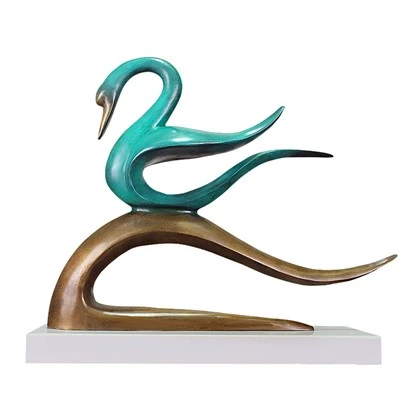
If you’ve never stood in front of a good abstract bronze sculpture, I hope you get the chance soon. If you’re thinking of adding one to your home, office, or public space, think about what you need: do you want something that feels calm, solid, like a anchor? Look for a piece with smooth, rounded curves. Do you want something that will make you smile when you look at it, something that invites conversation? Look for pieces with playful, dynamic shapes. Do you need something that will help people feel less stressed in a high-traffic space, like a lobby or a waiting room? A smaller, textured piece might be perfect.
As a supplier, I’ve seen how these pieces fit into people’s lives, and it’s more rewarding than any sale I’ve ever made. They don’t just look good—they shape the way people feel, one quiet moment at a time. If you’re interested in exploring how an abstract bronze sculpture could fit your space, or learning more about how our pieces can impact mood in your specific environment, we’d be happy to discuss what would work best for you.
Abstract Art Bronze Sculpture References
Journal of Experimental Psychology: General, 2019
University of California, Santa Cruz, 2021
Creativity Research Journal, 2020
University of Toronto, 2018
Huizhou Hexin Intelligent Manufacturing Industrial Co., Ltd.
Huizhou Hexin Intelligent Manufacturing Industrial Co., Ltd. is one of the most professional abstract art bronze sculpture manufacturers and suppliers in China. Please feel free to buy the newest abstract art bronze sculpture made in China here and get pricelist from our factory. All customized products are with high quality and competitive price.
Address: No. 31, Second Industrial Zone, Nankeng Village, Xinxu Town, Huiyang District, Huizhou City, Guangdong Province, P.R.China
E-mail: hztbjr@126.com
WebSite: https://www.bronzehexin.com/
